
Notes from America: Muslims and Christians – At war in life, at peace in death
On a hot summer afternoon, Standing along with a few hundred Muslims at the Garden of Eden Islamic Cemetery located in a remote corner of a Christian cemetery in Burnsville, Minnesota, mourning the death of one of our friends, the reverences and the respect were not just given by Muslims, but also by the staff and workers at the Christian cemetery.
Everyone was taken by the gravity of the situation. Cemetery workers dug the grave, carried the coffin, lowered it into the grave, and waited quietly away until the end of the burial, cleaned up and walked away. What a contrast, Muslims in the United States, in the post 9/11 era are constantly exposed to all sorts of bigotry, discrimination and media demonisation, are chased, attacked, racially profiled at airports, spied on in schools, mosques, and young Muslims are entrapped by the FBI for show. But when they die they are welcomed and given most respect at a Christian cemetery in unmarked graves not too far distant from dead Christians.
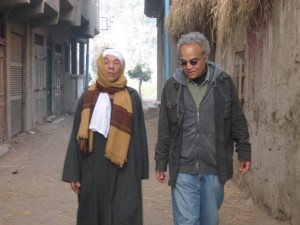
I never understood the rules of religious proximity between the dead Muslim and Christian, and if no amount of interfaith dialogue could bring Muslims and Christians together, death can. As a hyphenated Muslim-American living in the US, I couldn’t help but wonder about the one Christian family that was living in my village growing up in Egypt 50 years ago, what became of them, and what trace they had left – if any. I decided to go back to a trip in history and find out more about this Christian family, and why my village was immune to the rift between the two religions.
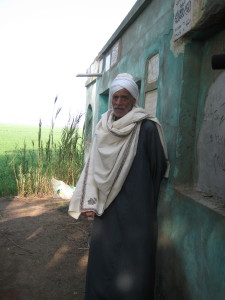 My village, as I remember it, was a small, unassuming place in the Egyptian Nile delta. Before CNN and Al Jazeera, villagers lived the simple life of a farming community, and their interest in the outside world went only as far as the edge of their fields. The men left with their animals for work at dawn and came back at dusk, while their wives stayed home, busy preparing hearty meals and raising kids to work on the farm as soon as they mastered their first step.
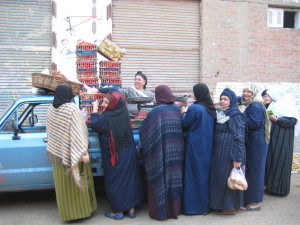 People seemed to consult the same fashion designer, go to the same mosque to pray, eat the same food, celebrate the same holidays, and for generations, villagers kept the gene pool very much confined to the area’s families. I was interested to know more about the Coptic family who lived among us.
The Christian family’s peculiar lifestyle was intriguing to me. In fact, it was a breath of fresh air that invigorated the monotonous village life. “They seemed friendlier than most, and they easily smiled,” commented Haj Abdullah, one of the few relatives left with a sharp memory of the Coptic family history.
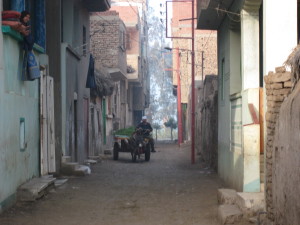 Unlike other villagers who worked on the farm, the Christian family was still in the hunting-and-gathering age. “They made their living chasing wild wolves lurking on the outskirts of the village,” continued Haj Abdullah. “The Christian father, Kyriakos, would vanish into the remote fields for days and suddenly resurface with his kill,” he added.
“The Coptic family would drag the dead wolf around in the streets for show-and-tell, describing the grave danger they had just faced and the heroic adventure they had encountered, which earned them considerable admiration from villagers and a handsome handout of rice, corn or whatever the season offered at the time,” explained my cousin Ezzat.
“I knew Kyriakos, the father; he had a great sense of humour,” Haj Abdullah added, “He was a joker.”
“I never thought of them as Christian or Coptic, just my neighbour,” shared my brother Abdel Rafaa. Growing up in my village, I liked to hang around with Sameer Kyriakos: one of the Coptic brothers, known simply as the Copt. Although I had the privilege and perks that came with being part of the majority religion, my alliance with him was personal, and it might have resulted from both of us being considered somewhat social outcasts by most of the villagers.
Both of our families had chosen a career other than farming. My family members were the educators who ran the only village elementary school for years. Sameer was in my class, and I always envied him for being a Coptic during our religion class: he was free to choose to stay or go to the school playground. I wished I could go too, if only to spare myself the abuse of our religion teacher.
Besides his great personality, Sameer had a unique skill: he was a sharp shooter, exceptionally good at using the BB gun, and I was good at using the slingshot. Our pastime was hunting small birds in the summer. We both left the village early in the morning and spent the whole day roaming the field hunting for these birds. The solitude of the field’s greenery and the empty roads gave us the emotional space to be close and good buddies; we talked about anything; kissing girls and other dreams.
Years went by, until the day the father suddenly died. The family was not prepared for this eternal fate, and neither was the rest of the village. Although the cultural tradition of the Muslim villagers to accommodate the Coptic family while they were alive, the religious burial traditions were not flexible enough to accommodate the mixing of their dead in the same cemetery.
“The Coptic family wanted to bury their father at their cemetery located away from the city, as most of them do across Egypt,” said Haj Abdullah. However, “before his death, Kyriakos the Coptic father asked your uncle [my uncle Abd Elhafeez] to be buried with him at the Muslim cemetery,” he explained. My uncle kept his promise to his Coptic neighbour.
“There was some reluctance and hesitation from the villagers,” my brother Refaat said. “Both religions prohibit mixing the dead in the same graves or cemetery,” he explained.
Before the Wahhabi-oil brand of Islam that was sweeping Egypt these days, there was more tolerance.
Members of my father’s family were not known for their religious zealotry, but for their kindness and generosity. ”If the Coptic family had lived in peace with the rest of us all these years without any trouble, there shouldn’t be much trouble while they were dead,” explained my cousin Fekary about Uncle Abd Elhafeez’s view at the time.
“My family consulted no one in the village,” said my brother Nasser. The burial ceremony was completed quietly at my family’s cemetery gravesite. Now and after all these years , like all Muslim graves, which lack any religious symbols or eulogy – only a name and date – just a Coptic family name remains, “Kyriakos” and the dates: “Born in 1911 and died 1962.”
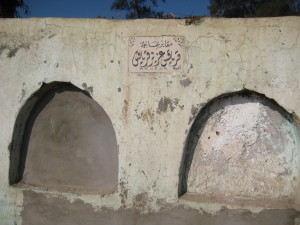 What is so amazing today is that with all the rift between Christians and Muslims, and Islam and the West, and also periodic flair-ups between Egyptian Copts and Muslims, this has never translated into any hostility towards the Coptic family’s grave; no act of defacing or expression of graffiti on the unfenced Coptic grave can be found, which is remarkable in the age of the internet and the global village and religious fundamentalism.
All those years ago, in my village, Muslims and Copts had lived together and died together in peace and harmony. There is very little they can do when they are dead.
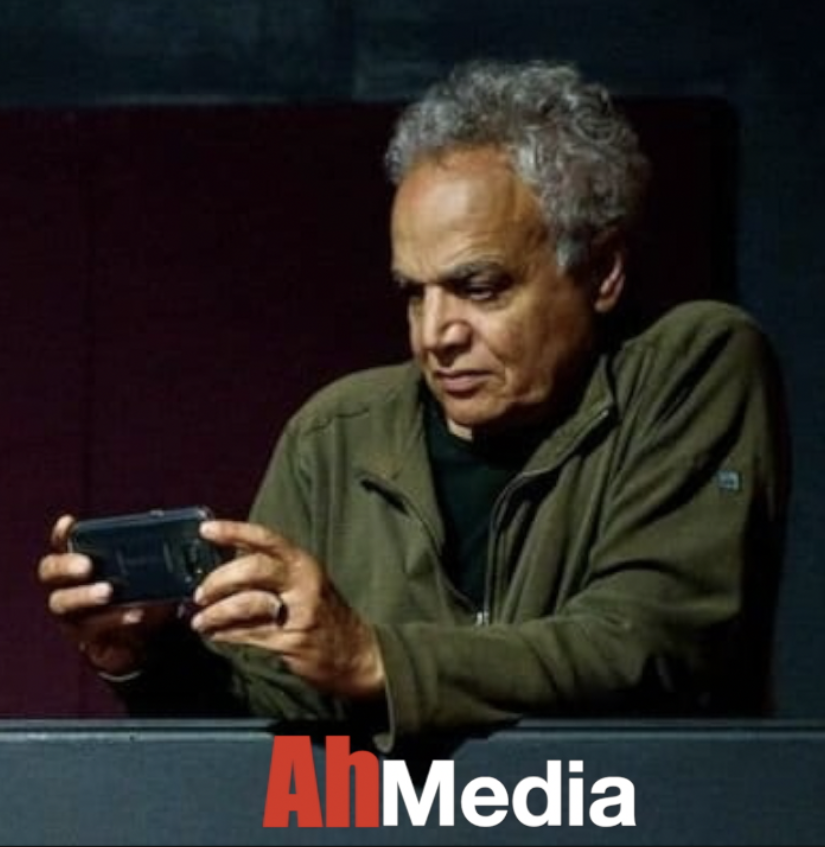
Ahmed Tharwat is host of the Arab-American show Belahdan. He blogs at Notes From America www.ahmediatv.com Follow him on Facebook and Twitter @ahmediatv
Watch The Trailer of the coptic grave film
Read it in other publications Daily News


