Qamaria Yemeni Coffee Shop, a visit that could get you deported!!
“I’m in love with Yemeni coffee and on a mission to share it with the world,” wrote Hatem Al-Eidaroos, the Co-Founder Of Qamaria a Yemeni coffee shop inside a small strip mall in Eden Prairie, where the first Starbucks once stood. — Hatem wasn’t just offering a new place to grab a latte for your ego. He was inviting Americans into 5,000 years old tradition , one brewed in the mountains of Yemen, the birthplace of coffee itself. The place looks modern, with the electronic menu on the wall showing what they are serving, only one kind of coffee, which comes from the birthplace of coffee, 5000 years ago, Yemen coffee with cardamom.
Coffee shop drive-thru is an American invention for the rest of the world, hard to swallow. The idea of coffee shops as the founder of Starbucks, Mr. Schultze invasions it while visiting Italy, is to create a third place to rest away from home and work.
It was reported that Caribou coffee shops having tough time to stay open; where the closing hours for many Twin Cities locations show sporadic times earlier than the times customers have been used to. This is not just a caribou issue, lots of other coffee shops too finding hard to stay open. Americans drink about 146 billion cups of coffee per year. The average American drinks about 3.1 cups a day. In the last year or two, these numbers went up due to the pandemic and the lockdown where people drowned their depression in coffee and alcohol. Coffee is the most significant source of caffeine in America. More than half of Americans would rather skip their morning showers than their morning coffee. Drive-thru morning coffee extended rush hour to two rush hours. People leave early to get their morning fix; Millions of cars would line up at coffee shops’ drive-thru windows to get a $5 cup of coffee is probably the same people who would drive miles to Costco to save 5 cents on gas; Americans are extremist consumers. We drive fast on freeways to get home and sit on the couch to watch TV for hours. Coffee shops drive-thru is an American invention that is very hard to swallow, the idea of coffee shops as the founder of Starbucks, Mr. Schultze invasions it, is to create a third place to rest away from home and work. During the pandemic, going to coffee shops’ drive-thru to get your coffee is one of few safe outdoor activities where people get a glimpse of social activities from the privacy of their cars. Coffee shops are empty inside; however, the drive-thru is always busy, where people wait for up to 10 to 15 minutes to fill up their coffee. Due to labor shortages, coffee shops now open shorter hours; some even closed. On a gloomy, cool early Saturday morning, driving through the Edina neighborhood, there was nothing to do or a place to go enjoying the irrelevance of the surroundings. I stopped to get a cup of coffee at Caribou on the corner of 70th and Interlachen and Vernon. Edina. The parking lot was Empty; I got out of the car, walked to the Caribou, pulled the door, it is locked, a sign on the door to inform you that “due to labor shortage we are closed, check our website or our apps for updates. “A few tables outside where they didn’t enforce the closing decree, tables were open! I sat at the table next to the closed doors, and I’m not a morning coffee person anyway. I already had my breakfast and drank my morning tea at home. I Sat down and watched things happen around the busy corner. The first car arrived, a middle-aged lady slowly stepped out of her car, she didn’t seem to be in a hurry, walked to the coffee shop door, tried to open, read the closing sign and giggled, _ Ooh, close She walked away, disappointed. A big SUV stormed the parking lot, a tall young man rushed out of his car, he was screaming to someone in the car “Stay in the car, Ill get it” like a hunter in the jungle, he rushed to the coffee shop door, tried what it seemed like a break-in, tried a few times, looked inside, _ Shit, looked toward my table, “Nobody wants to work anymore! Inaudible frustrating message targeting Nobody! He walked back to his car and sped away, and he didn’t even read the closing sign. A lady walked across the parking lot toward the door, acknowledged my present; _” good morning”, pulled the door genteelly, locked; deliberately read the sign -“Aha … closed, “she quietly walked to a table across from mine and sat down staring, talking on her phone. Three women came in two cars together, walked to an empty table didn’t even know the store was closed. Waited till another friend who came later; they all walked to the door,. Tried to open, tried again, one reads the sign, and all started giggling. “let’s try the one by Lund’s & Barley and walked back to their cars as another young man was parking his convertor, walked to the coffee shop’s door read the sign before even trying to open the door, and walked away. Car after the car started pouring in, going through the same drill, different people with different reactions, no one struck a conversation, or wondered or shared their frustrations or rages, someone said, “Madness is no madness when it is shared”. Later, a Mini Van rolled in, a woman with her hijab open the door, a few children screaming inside the car. She ignored the commotion and walked to the coffee shop door before she tried to open the door; she noticed my present, slowly came to my table _” Salam Allikom… _” Salam Alllikom..” _” Don’t you know me; _” Well, should I” – … I know you, you still doing your show, (these another way of saying I don’t watch your show) _ Yes I do _ “you haven’t changed, just more gray hair!! _ I’m sorry you guys wear this hijab thing, then all look the same; we both laughed; she walked back to the coffee shop door. _ “it is closed today!'” I told her
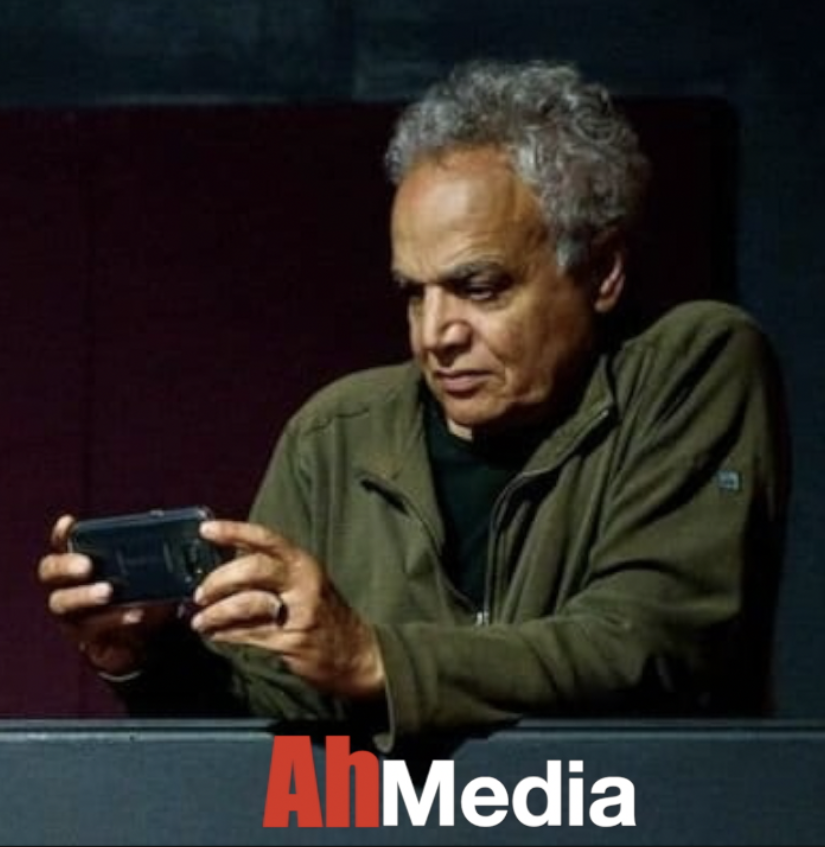
Ahmed Tharwat
Host and Producer of Arab American TV show BelAhdan
As racially-charged tragedies unfolded in communities across the country, the chairman and ceo of Starbucks didn’t remain a silent bystander. Howard Schultz voiced his concerns with partners (employees) in the company’s Seattle headquarters and started a discussion about race in America.
Howard Schultz is the CEO of Starbucks, a coffee company that as he describes it, “is a third place away from home and work where Americans can come and enjoy drinking a good cup of coffee sitting down.” Before Starbucks, Americans usually drank coffee on the run and everyone drank the same kind of coffee – black coffee in a Styrofoam cup. Every morning it was like filling up their morning caffeine fix from any gas station or a convenience store. For lots of Americans, it was the most mundane decision a person had to make before their lives got complicated in the everlasting consumer culture. Today, Starbucks theoretically can make more than 100,000 combinations of different kinds of coffee drinks, expanded to more than 20,000 stores in the USA and same number worldwide, spread in 55 countries around the world, even inside the Forbidden City in china.
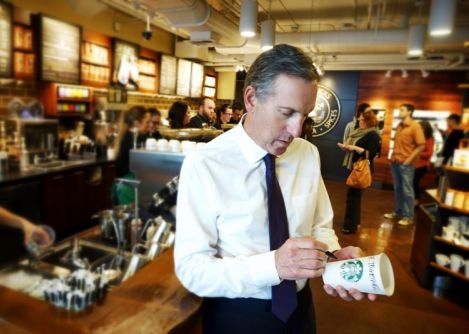
Schultz is already well-known as one of this generation’s CEO social activists, a group which includes Goldman Sachs’ Lloyd Blankfein, Duke Energy’s Jim Rogers, and Google’s Eric Schmidt — and other high-ranking corporate leaders like Facebook’s Sheryl Sandberg. These leaders think they can transform society and solve major problems over a cup of coffee or a marketing glitz. In 2009, the poised newly elected president Obama tried to have a conversation about race over a beer, when he invited a white police officer who insulted a black Harvard professor inside his own house to the white house for a beer with the black professor. Now, the enthused CEO Schultz has tried to start a conversation about race in America over a cup of coffee, asked his baristas to engage customers in the conversation, and write #RaceTogether on coffee cups before handing them to customers. The message was meant to be as he puts it “just the catalyst” for a broad conversation about race after a year in which the topic has been figured prominently in news headlines and dinner-table conversations across America, especially after a few fatal incidents where white policemen killed young black men. The campaign only lasted one week before it was cancelled in its 20,000 stores and Starbucks employees were told to stop writing “Race Together” on your coffee cups. The problem with Mr. Schultz’s #Racetogether national conversation invitation is that people actually went to Starbucks and got into the conversation but Starbucks was more interested in racing in selling more coffee than having a long conversation about race. Here are a few customer tweets in response to the campaign:
“Starbucks #RaceTogether is actually useful — as a demonstration of what’s wrong with the way US employers treat their workers.”
#RaceTogether is trending nationwide on Twitter tonight, not really for the reasons @Starbucks wanted…”
“Really mad at this Starbucks employee who wrote #RaceTogether on my croissant.”
“ @starbucks started #RaceTogether conversation this week, hope next week’s conversation will be about #IslamophobiaTogether.” actually that was my tweet once I heard about the #RaceTogethr campaign.
Journalists went to Starbucks to try talking about race, but they quickly realized that making conversation with a barista really holds up the line, and the last thing you want to do in a Starbucks coffeehouse is to hold up the line. However, coffee houses in the Arab world are places where people actually get together, sit down and have a conversation. Egyptians have mastered the art of sitting on cafés; it became a sort of activities. People actually say, “I’m sitting on the café,” when asked what you are doing. There are more cafés in Cairo city than minarets. The way Egyptians experience coffee shops is different than the hyper-functioning Americans. Starbucks, which was meant to be a third place away from home and work, has become work, and the place where people are supposed to go inside and enjoy a sense of community, now has a drive-through to get your coffee without ever getting out of your own car – a very alien concept to most Egyptians.
Coffee houses in Egypt are traditionally known for their intellectual and politically vibrant nature, especially in downtown Cairo where famous café like Riche Café in Talaat Harb Square were filled with intellectuals, spies and politicians. Plans were hatched, alliances forged, screeds written. In an Economist article, Kamel Zuheiry, a columnist and 1960s regular remembers, “We continued to discuss in the café what we started in the newspapers. The one constant during decades of caffeinated talk was the question of our Egyptian identity and our Egyptian-ness. The regulars were divided into turban-wearers (traditionalists) and fez-wearers (modernists), even if few of them actually wore headgear.”
I visited Egypt during the heydays of the revolution in 2011. The cafés once again became an extension of the Egyptian political landscape, a replica of the Tahrir Square spirit. People came from the square, stopped at a café, had a drink, continued their discussions, exchanged ideas and would then #RaceTogether back to the Square. As for folks at Starbucks, everyone is back to square one, just quietly making coffee served in Styrofoam cups.
Ahmed Tharwat 4/2/2015
Host and Producer of the Arab American TV show BelAhdan
His articles published in national and International publications
My visit to Starbucks to have a conversation, I used my phone camera (Technical issue)
My Interview with Professor Owens ,,, Corporate Jihadists